
Parents trust other parents
The most persuasive thing about your school isn't written by your marketing team. It's said in a car park, on a WhatsApp group, at a birthday party.
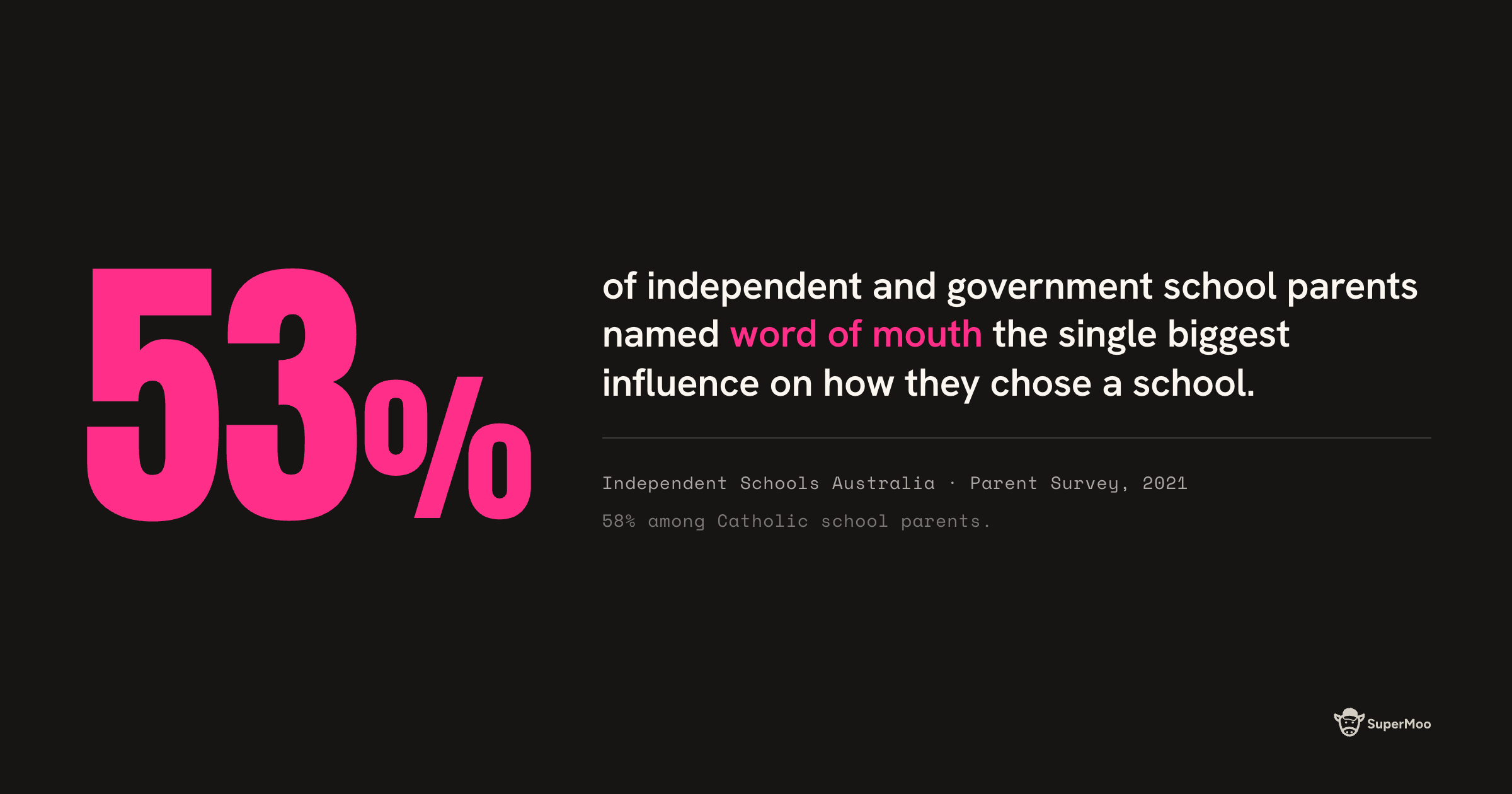
Independent Schools Australia's 2021 parent survey found word of mouth was the biggest influence on school choice, named by 53% of independent and government school parents and 58% of Catholic school parents. Ask any head of admissions and they'll tell you the same thing without the survey. Families show up because another family told them to.
So the question isn't whether word of mouth matters. It's whether any of it exists on your website.
Most school sites answer that with a text quote in italics next to a stock photo. "The teachers here truly care about every child. - Sarah, Year 4 parent." Nobody believes it. It could have been written by anyone, and in a lot of cases it was. That problem got worse the moment AI could produce a hundred warm, believable-sounding parent quotes in about nine seconds.
A parent on camera, in their kitchen, with the dishwasher going in the background, saying the name of the teacher who helped their kid settle in? That's not something you can fake, and families know it.
What a good school testimonial actually sounds like
Short and specific beats long and polished. Every time.
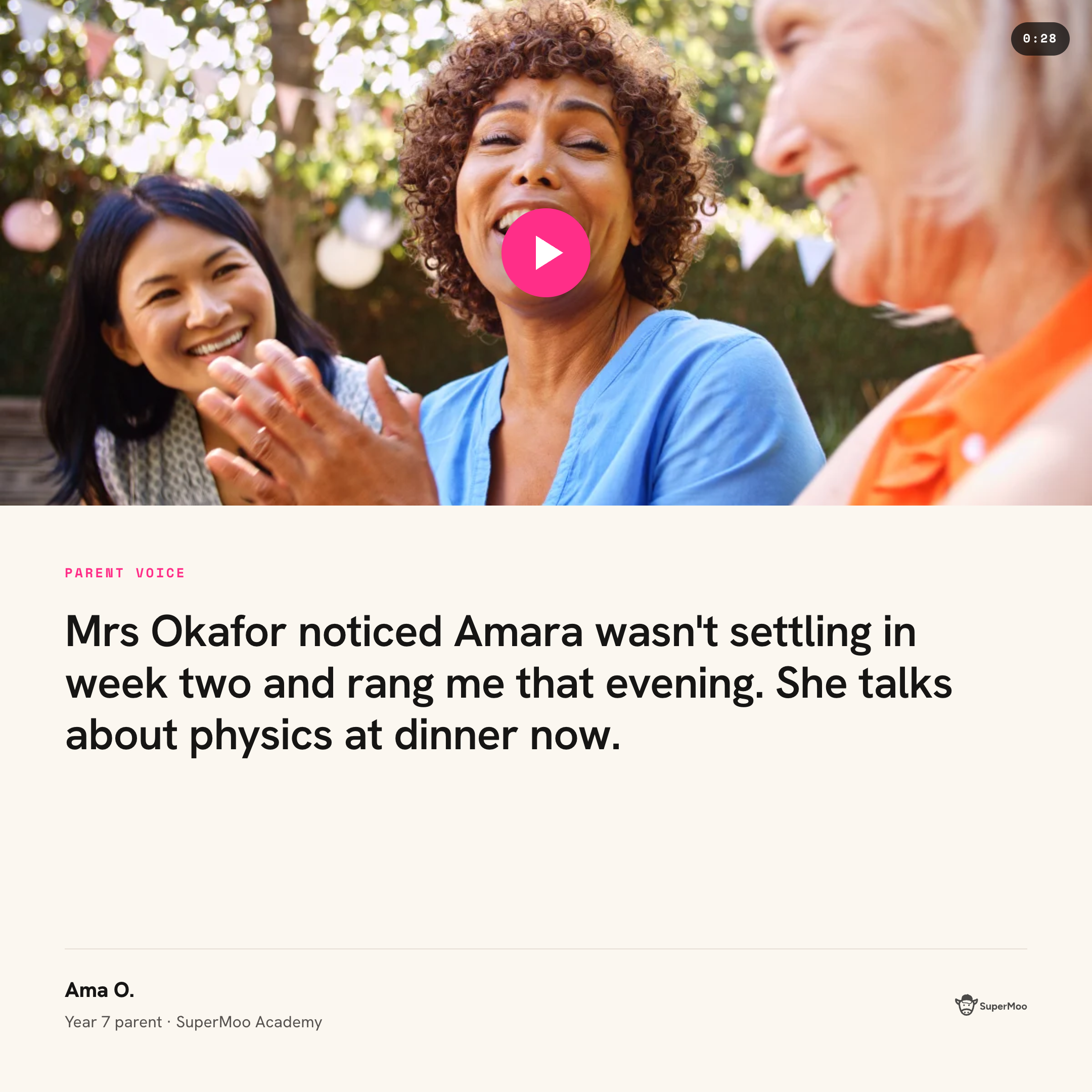
The testimonials that move families are the ones with a detail in them. A teacher's name. The week the transition to secondary was rough and what the school did about it. The fact that their daughter now talks about physics at dinner. Specifics are the proof.
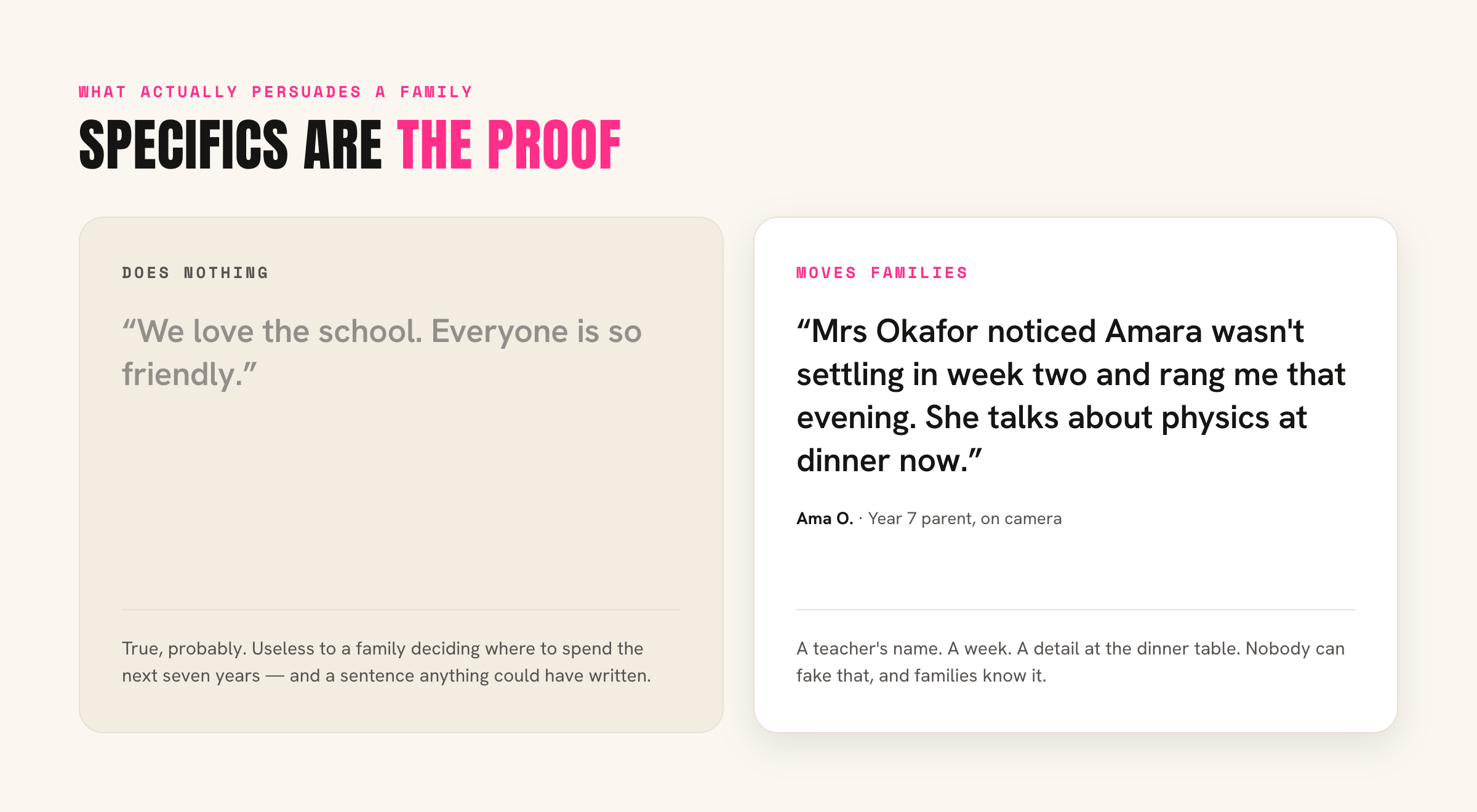
The ones that do nothing are the general ones. "We love the school. Everyone is so friendly." True, probably. Useless to a family deciding where to spend the next seven years.
You get specifics by asking a specific question. Not "tell us about your experience." Something like:
- "What surprised you most in your first term here?"
- "What would you say to a family who is on the fence?"
- "Tell us about a teacher who made a difference for your child."
One question per campaign. Give people a narrow thing to answer and they answer it well. Give them a blank page and they freeze.
What is a school video testimonial?
A school video testimonial is a short clip, usually about 30 seconds, of a parent, student, or alum answering one specific question about their experience. Recorded on their own phone, approved by staff, and embedded where families make enrolment decisions, it works as on-page word of mouth.
Key concepts
- Campaign question
- The single, specific prompt you ask families to answer, like 'What surprised you most in your first term?' One question per campaign gets better answers than an open brief.
- Consent checkbox
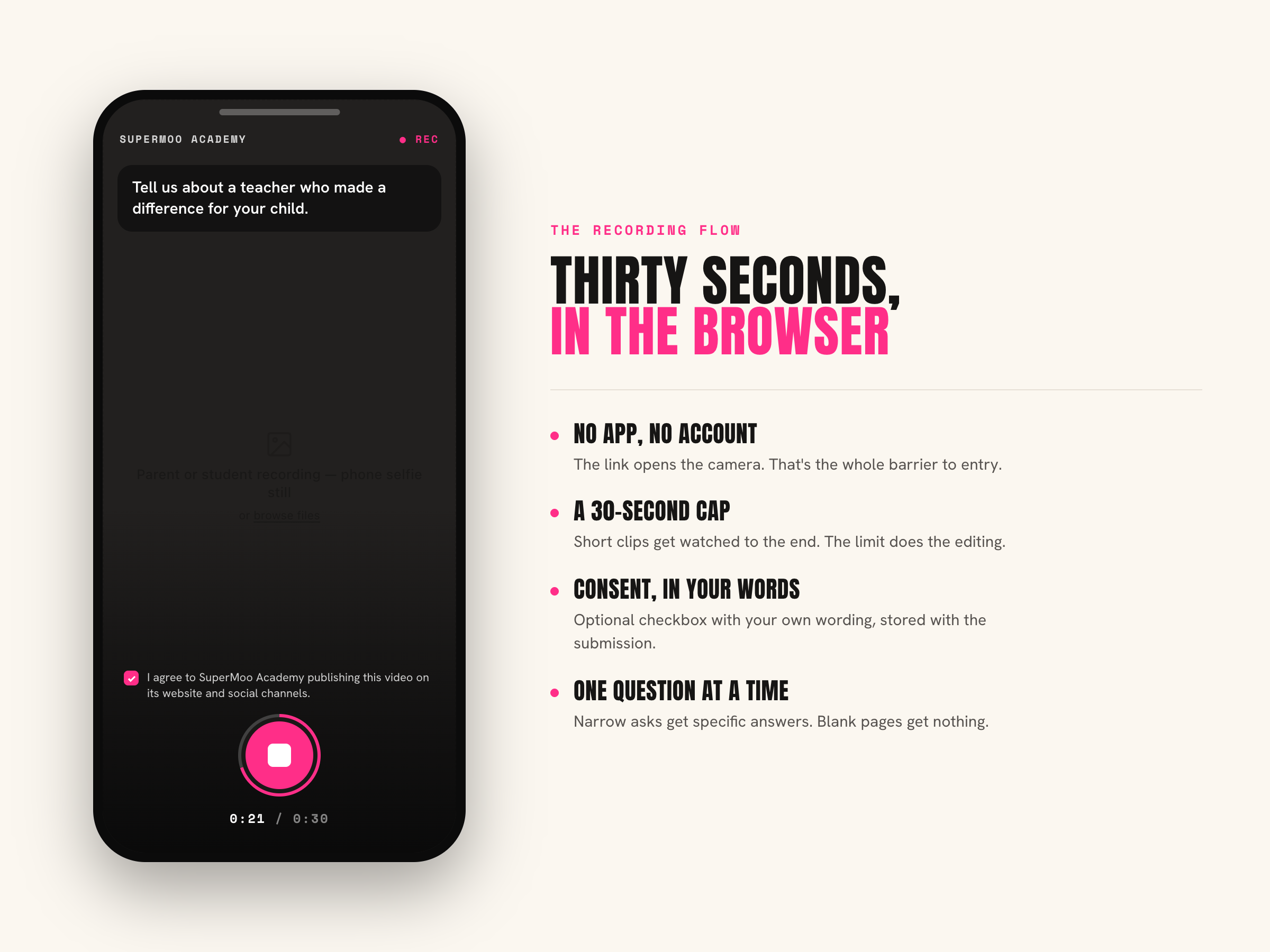
- A tick-box with your own wording, shown before recording and saved with each submission, so you have a record that a parent or student agreed to publish.
- Approval queue
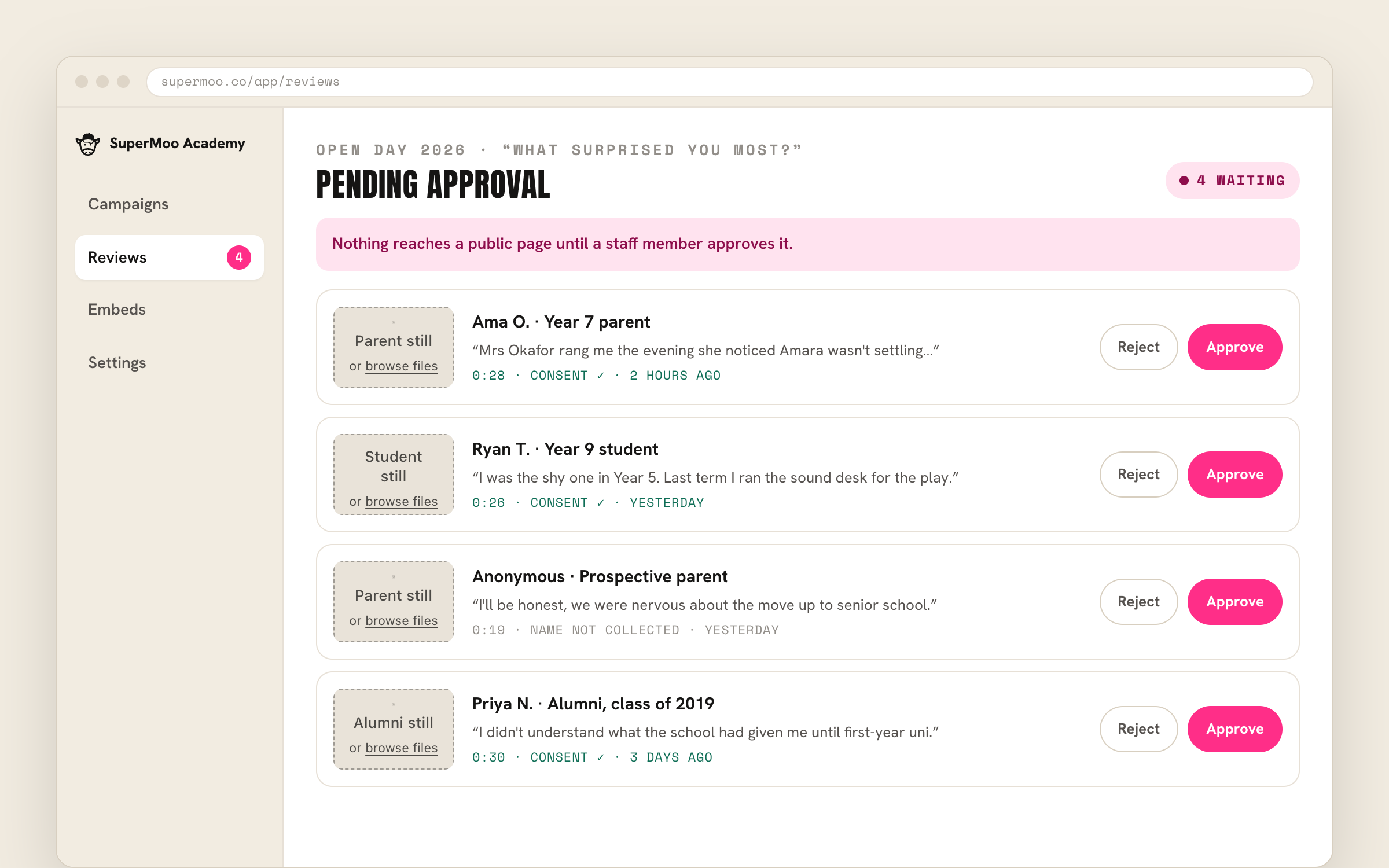
- A pending list where every recording waits for a staff member to approve, reject, or download it. Nothing reaches a public page automatically, which matters for safeguarding.
- Video wall
- A self-updating grid of approved clips embedded on a page. New approvals appear without anyone editing the website.
SuperMoo insights
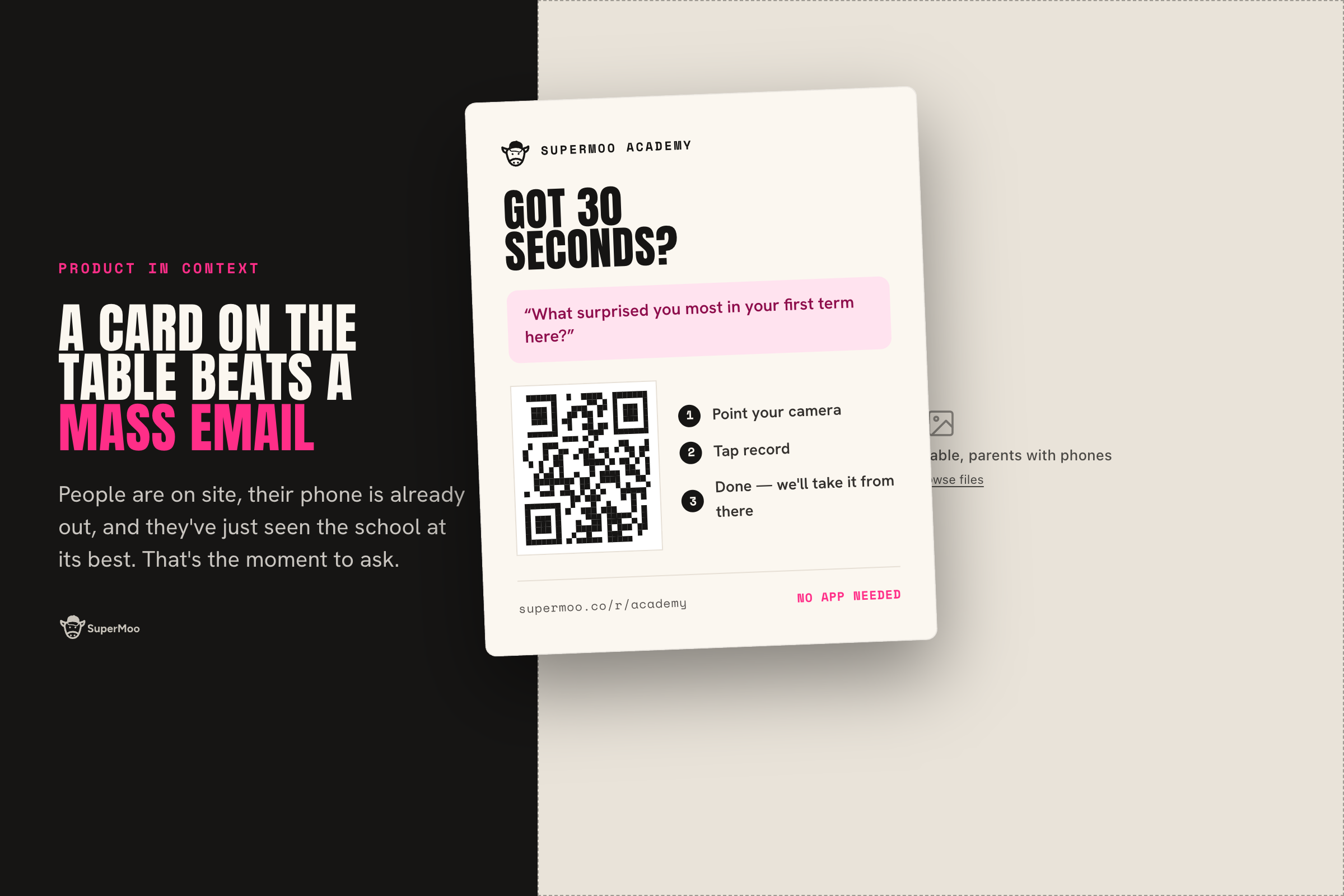
- The move that changes results isn't better production, it's better timing. Ask at an open day with a QR code on the table and you'll out-collect any polished filming day.
- AI can now write a hundred believable parent quotes in seconds, which is exactly why an unfakeable 30-second clip of a real parent is worth more than it was two years ago.
How to run this in a week
This is the part where most schools overthink it. You don't need a plan, you need a moment and a link.
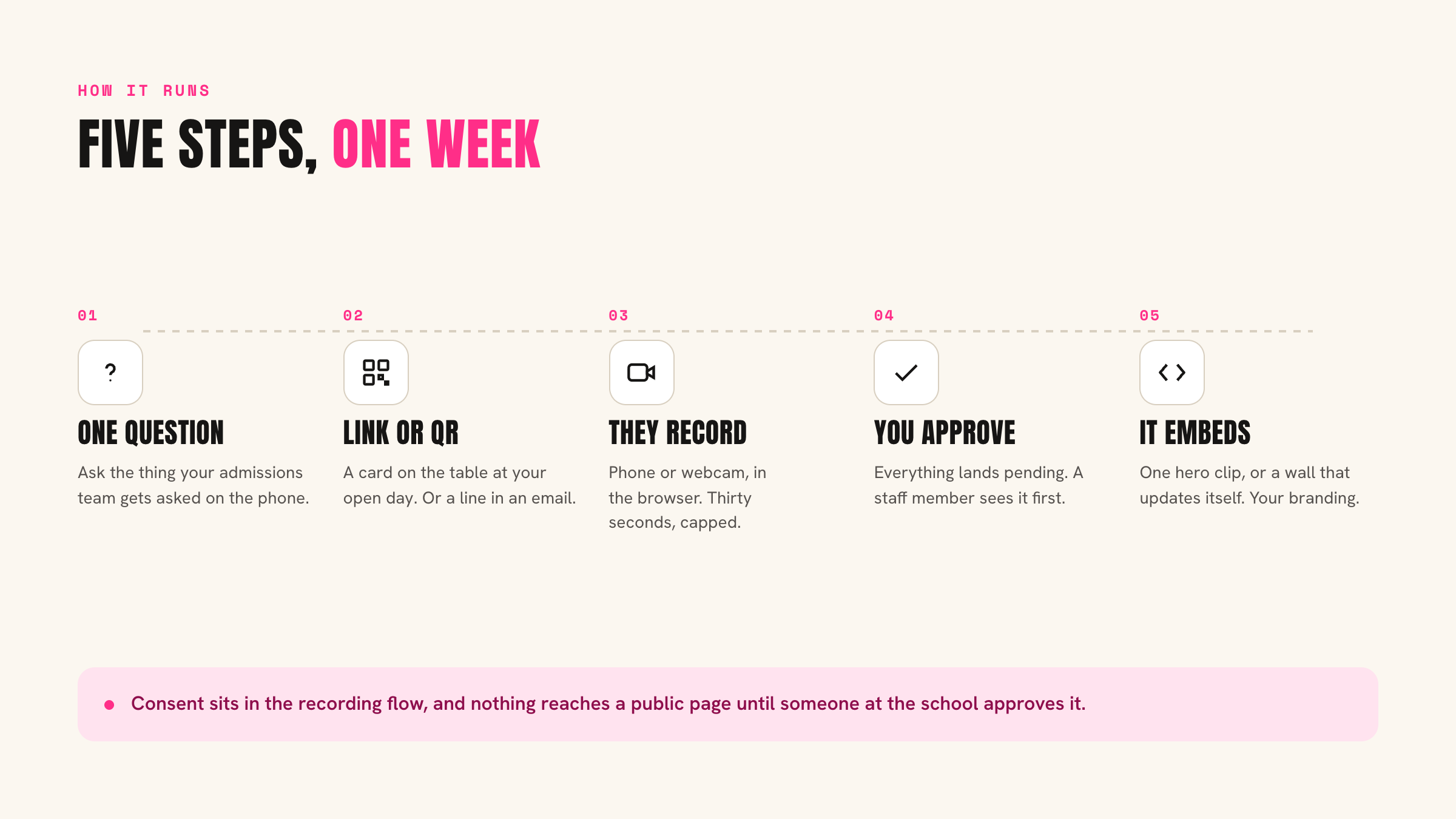
1. Pick one question
Start with the one that maps to the objection you hear most in admissions calls. If families worry about the move up to senior school, ask about that. Your testimonials should answer the questions your admissions team gets on the phone.
2. Pick the moment you ask
Timing does more work here than wording. Ask when parents are already feeling good about the school:
- At an open day, with a QR code on a table card near the exit
- The evening after a concert, a play, or a sports final
- End of term, when the report has just landed
- Right after an offer is accepted, while the relief is fresh
- Alumni events, where you get the long view from families who already went through it
A QR code on a printed card at an open day is the highest-yield version of this. People are on site, they have their phone out, and they're already in the mood.
3. Handle consent up front
Consent belongs in the recording flow, before anyone hits record. A checkbox with your own wording, saved with the submission, so you're not chasing an email trail six months later trying to prove a parent said yes.
4. Approve everything before it goes live
For a school this isn't a nice-to-have. Nothing should be able to reach a public page without a staff member looking at it first. That's a safeguarding requirement, and it's also just sensible. Some recordings will have another child in the background. Some will name a member of staff in a way you'd rather not publish. You want a queue, not a live feed.
Loop in your DSL and check what your privacy notice already covers before you launch, especially if students will be recording. Every school's policy is a bit different and yours is the one that counts.
5. Put them where decisions get made
A testimonial on a page nobody visits is a testimonial that doesn't exist. Put them:
- On the admissions and "how to apply" pages
- On your open day landing page, right next to the booking form
- On the fees page, where hesitation actually happens
- In your enquiry follow-up emails, as a link with a thumbnail
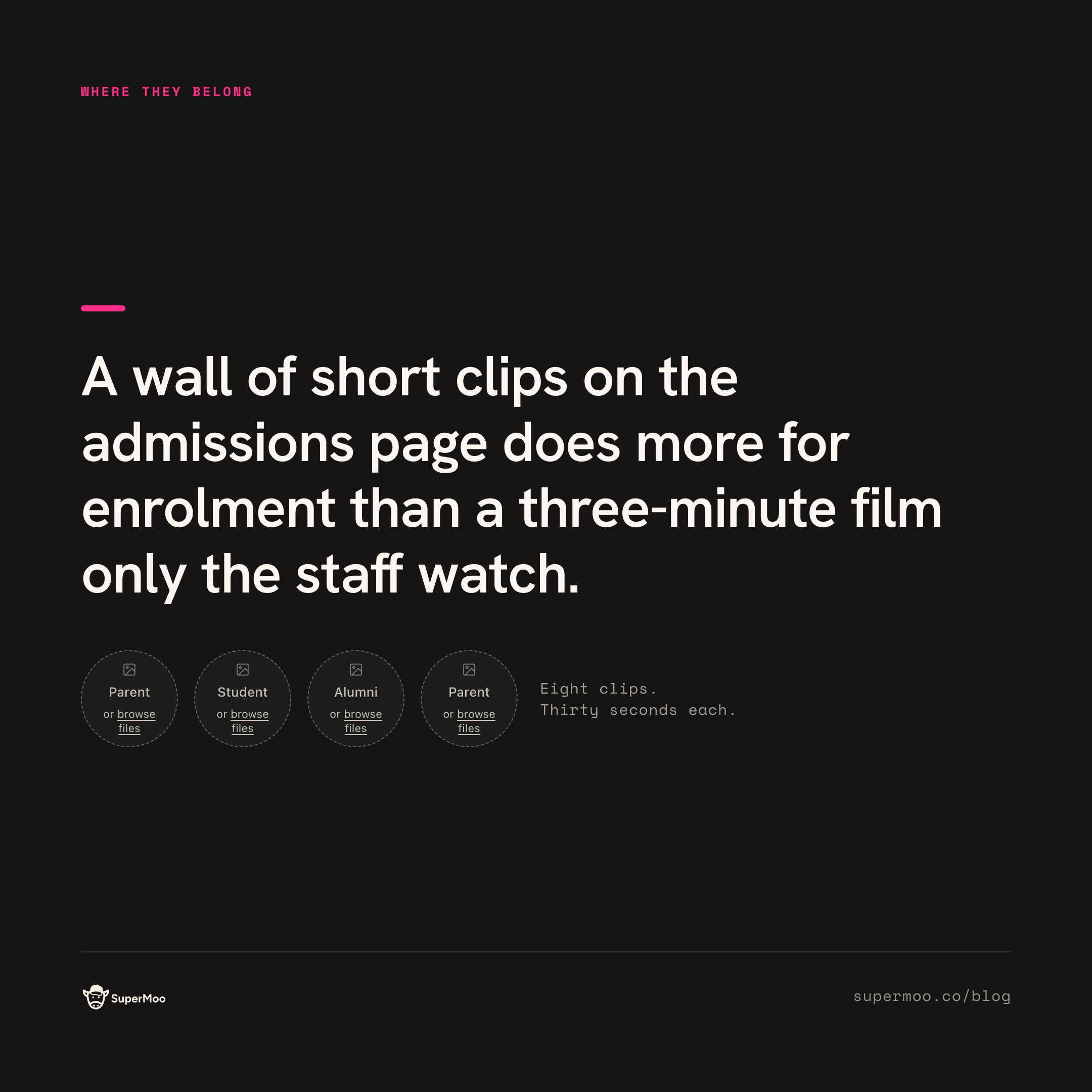
A wall of short clips on the admissions page does more for enrolment than a beautiful three-minute film on the homepage that only gets watched by staff.
Where schools get this wrong
Asking everyone at once is the big one. A mass email to 400 families gets you four responses and a bad mood. Ask 20 families in person at a moment when they're happy and you'll get better material out of it.
Asking for too much is the other one. Downloads, logins, scheduling a filming slot, signing a release form in advance. Every extra step loses people. Recording in the browser with no app and no account is the whole point.
Then there's who you ask. Most schools only ask parents. Students are more convincing than anyone, especially to other students. Staff and alumni carry weight too, and alumni give you the long view a current parent can't.
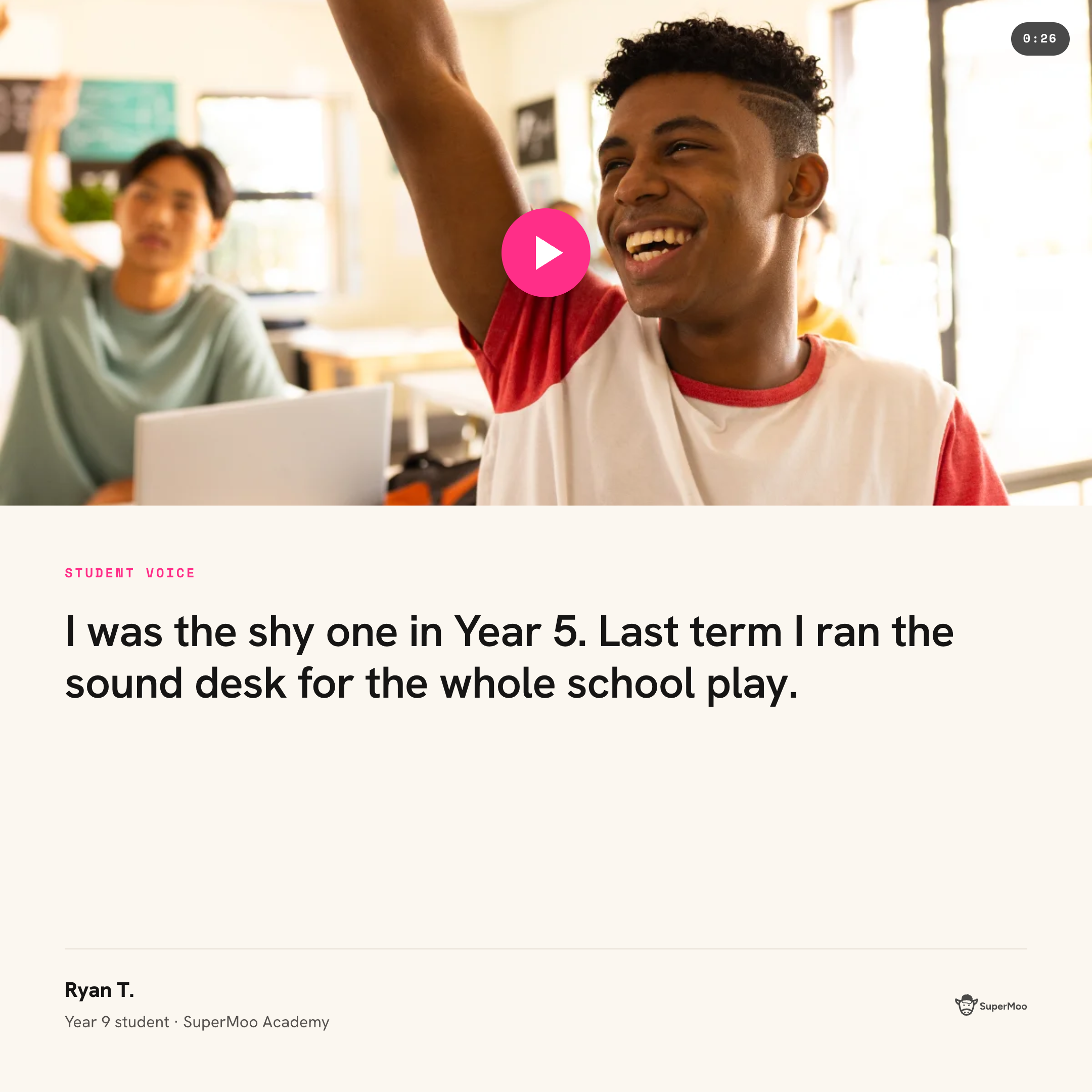
And most schools only ask their happiest families. A parent who admits they were nervous about the move up and then explains what changed their mind is worth ten glowing ones.
Last one. Schools treat this as a campaign when it works better as a habit. Collect a few every term, forever. The wall keeps growing and the stories stay current, which matters, because a testimonial from 2019 reads like an artifact.
How ReMoo handles it
ReMoo is the video review side of SuperMoo. We didn't build it for schools originally, and then educators started showing up on our LinkedIn page, and it turned out schools need this more than most businesses do. So here's how it maps to the workflow above.
You create a campaign with your question. You share it as a link or a QR code. Parents and students open it and record straight from their phone or webcam, no app and no account, with a 30 second cap that keeps things tight. Consent is an optional checkbox with your own text, and you decide whether to collect names and emails at all.
Everything lands in your dashboard as pending. Nothing goes public until you say so. You approve, reject, or download the raw file if you want to use it somewhere else.
Approved reviews embed as a single hero testimonial or as a wall that updates itself, so new ones appear without anybody touching the website. They play in your school's own branding, in the SuperMoo player, which loads in 0.18 seconds and doesn't run ads or recommend somebody else's video at the end.
And ReMoo is included free on every SuperMoo plan. No per-review fees.
Try SuperMoo Free → See SuperMoo for Schools →
Give it a shot
You already have the material. It's sitting in your parent body, and most of it has never been recorded because recording it felt like a project.
It isn't a project anymore. One question, and a QR code on a table at your next open day.
Try SuperMoo Free → or book a 15-min call and we'll set up your first campaign with you.
Moo on! 🐮