Most tourism businesses spread their marketing too thin: a little Instagram, a listing on two OTAs, an email list nobody writes to and a website that hasn't changed since launch.
A tourism marketing strategy fixes that by deciding which channels do which job. This guide is for tour operators, hotels, attractions and activity providers. It goes channel by channel: what each one is good for, what it costs you and how to tell if it's working.
What is a tourism marketing strategy?
It's a plan for how travelers find you, decide to trust you and book with you, and which channels you use at each step.
Demand is there. International tourist arrivals reached about 1.52 billion in 2025, up 4% on 2024 (UN Tourism, 2026). The hard part is getting your share of it without handing most of the margin to someone else.
A good strategy answers four questions:
- Who are your best guests, and where do they plan trips?
- Which channels bring them in for the first time?
- What convinces them to book with you, not the next result?
- How do you bring them back, or get them to send friends?
What is the best marketing strategy for a tourism business?
There isn't one best channel. The strategy that works is a small set of channels, each with one job, all pointing back to a website that converts.
For most small tourism businesses, that set looks like this:
- Your own website, built to turn visits into bookings.
- Google: your Business Profile, free listings and organic search.
- OTAs and resellers, used for reach but kept in check.
- Social media and video, for inspiration and proof.
- Reviews and guest videos, for trust at the moment of booking.
- Email and past guests, for repeat and referral bookings.
- Paid ads, once the rest converts.
- Partners, PR and your destination organization.
In our experience, Google organic has always worked best, and Google Ads brings the biggest volume. But with AI search taking hold and traffic declining, building the credibility that converts the visitors you do get is now crucial. So are videos that AI models can cite.
Channel 1: Your website
Every other channel sends people here, so fix this first. If a trip page is slow, hides the price or has no recent reviews near the Book button, every ad and post you pay for leaks.
The basics that move bookings: the full price and what's included, clear dates and availability, real guest reviews and photos, and online booking or a quick inquiry form. Our travel conversion playbook goes through each step, and the conversion rate benchmarks help you judge where you stand.
Channel 2: Google search and maps
For most travelers, Google is still where the trip turns into a short list.
Your Google Business Profile
Fill in every field, add real photos, keep opening hours right and reply to reviews. This is free and it's what people see on maps.
Google Things to do
Tour operators, attractions and activity providers can show their products on Google free of charge. Google recommends small operators connect through one of its connectivity partners, which usually means your booking system (Google Ads Help). If your booking software offers it, switch it on.
Organic search
Write pages that answer the questions your guests actually ask: "is this tour suitable for kids", "what to pack for the trek", "how to get from the airport". One clear, honest page per question beats a long page about everything. Our ranked list of ways to get more tour bookings shows where these fit against quicker wins.
Channel 3: AI answers and chat assistants
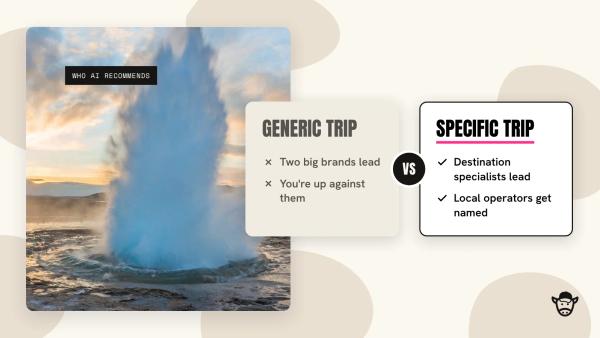
More travelers now ask an AI assistant before they search. In the past 12 months, 56% of US travelers used AI to plan, book or get help on a trip. That's up from 33% in the first half of 2025 (Phocuswright, 2026).
You can't buy your way into those answers, and nobody can promise you a place in them. What you can do is the same work that helps search. Put clear facts on your own pages: prices, inclusions and who it suits. Keep recent reviews coming, and show real guest voices people can check. Phocuswright found half of travelers who see AI answers in search engines still click through to the source sites, so the page they land on has to do the selling.
Channel 4: OTAs and resellers
OTAs bring reach you can't build alone, and they're growing. In tours and activities, OTAs took 37% of bookings in 2025, up from 28% in 2023, while operator websites fell to 25% (Arival, 2025). For independent hotels the OTA share is 63.4% (Cloudbeds, 2026).
Use them, but don't let them become the whole plan. Commission eats margin, and the guest relationship stays with the platform. Cloudbeds also found OTA bookings were canceled at 21.8%, against 10.6% for direct bookings.
A simple rule: treat OTAs as a way to meet guests, then give those guests every reason to book direct next time.
Channel 5: Social media and video
Social is where many trips start. In Expedia Group's 2025 Traveler Value Index, 61% of travelers said they find trip ideas on social platforms, up from 35% in 2022 (Expedia Group, 2025).
Video does more of the work than photos. In a separate 2025 Expedia Group survey of 7,000 travelers in seven markets, 71% said video had influenced their travel decisions, against 24% for static images (Expedia Group, 2025).
Pick one or two platforms and do them well, which is also VisitBritain's advice to small businesses (VisitBritain). Post real moments from real trips. Reply to comments. Link back to the trip page, not just your home page.
Channel 6: Reviews and guest videos
Reviews are where a short list becomes a booking. Three quarters of travelers in the Expedia Group study said they'd pay more for lodging with better reviews (Expedia Group, 2025).
Most of your best reviews sit on Google, Tripadvisor and booking sites, where they also help the competitors listed next to you. Bring that proof onto your own pages:
- Ask at the high point of the trip, while guests are still with you.
- Show recent reviews next to the price and the Book button.
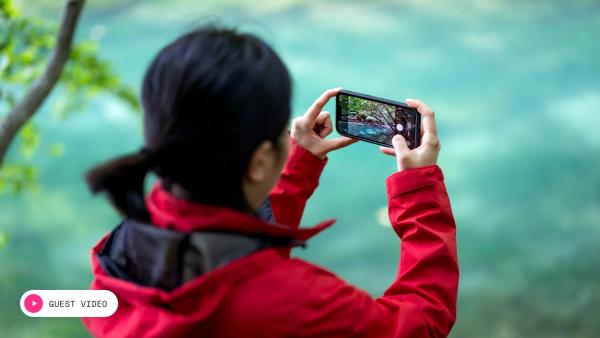
- Add short guest videos to your best trip and room pages.
That last step is what SuperMoo does. Guests record 30 to 60 seconds on their phone from one link or QR code, with no app. You approve each one, and it plays on your own site in your colors, with no ads. You can start a 7-day free trial. See how it works on the collecting and player pages.
Channel 7: Email and past guests
Your past guests are the cheapest bookings you'll get. They know you, they trust you, and they have friends who travel.
- Send a thank you within a day, with photos from the trip and a way to leave a review.
- Send a short note before the season opens, with new dates.
- Ask happy guests to forward you to a friend.
Keep it to a rhythm you can sustain. VisitBritain warns against bombarding subscribers and suggests checking data protection rules before you collect emails.
Channel 8: Paid ads
Ads speed up what already works. They don't fix a page that doesn't convert. Start small, send each ad to the matching trip page, and judge it on bookings, not clicks.
Channel 9: Partners, PR and your destination organization
Hotels can send guests to tours, tours can send guests to restaurants, and both can appear in your local tourism board's guides and press trips. These partnerships cost little and bring guests who arrive already trusting you.
What's the most common tourism marketing mistake?
The one we see most often is using stock images and not showing what the experience is all about. A generic sunset could belong to anyone. Show your boat, your guides, your groups and the moments guests talk about afterward, and use guests' own photos and videos once they've given permission.
What is a tourism marketing strategy?
A tourism marketing strategy is a plan for how travelers find you, decide to trust you and book with you, and which marketing channels do each of those jobs.
Key concepts
- Marketing channel
- A route travelers use to find or book you, such as Google, an OTA, social media or email.
- OTA
- An online travel agency, such as Booking.com, Expedia or Viator, that sells your rooms or tours for a commission.
- Direct booking
- A booking made on your own website, by phone or in person, with no commission to a third party.
- Google Things to do
- Google's listings for tours, attractions and activities, which operators can join free through a connectivity partner.
- Social proof
- Evidence that other people chose you and were happy, such as reviews, ratings and guest videos.
SuperMoo insights
- In our experience, Google organic has always worked best, and Google Ads brings the biggest volume. With AI search taking hold and traffic declining, building the credibility that converts the visitors you do get is now crucial. So are videos that AI models can cite.
- The most common marketing mistake we see small tourism businesses make: using stock images and not showing what the experience is all about.
How do you build a tourism marketing plan?
Step 1: Pick your best guest
Write down who books most and who you'd like more of. A family on a week's vacation plans differently from a group of retirees on a walking tour.
Step 2: Map the journey
List where that guest gets ideas, where they compare and where they book. Each step is a channel.
Step 3: Give each channel one job
Social for ideas, Google for discovery, reviews and video for trust, your website for the booking, email for the return trip.
Step 4: Fix the website first
Make sure the pages people land on load fast, show the price and carry real guest proof.
Step 5: Measure bookings by channel
Track where each booking came from. Cut what doesn't pay, and put more into what does.
Key numbers
- 1.52 billion international tourist arrivals in 2025, up 4% (UN Tourism, 2026).
- 37% of tour and activity bookings went to OTAs in 2025, up from 28% in 2023; operator websites had 25% (Arival, 2025).
- 63.4% OTA share of independent hotel bookings; OTA cancellations 21.8% against 10.6% direct (Cloudbeds, 2026).
- 61% of travelers find trip ideas on social platforms, up from 35% in 2022 (Expedia Group, 2025).
- 71% say video influenced their travel decisions, against 24% for static images (Expedia Group, 2025).
- 56% of US travelers used AI for travel in the past 12 months (Phocuswright, 2026).
Ready to put guest voices on your own pages? Start with the travel page.
Sources
- UN Tourism World Tourism Barometer, via Hospitality Net (2026)
- Arival State of Experiences, via PhocusWire (2025)
- Cloudbeds 2026 State of Independent Hotels (2026)
- Expedia Group 2025 Traveler Value Index, via Hospitality Net (2025)
- Expedia Group travel content study, via Hospitality Net (2025)
- Phocuswright: the fastest shift in travel behavior (2026)
- Google: Introducing Things to do on Google
- VisitBritain: reaching your audience with social media and email