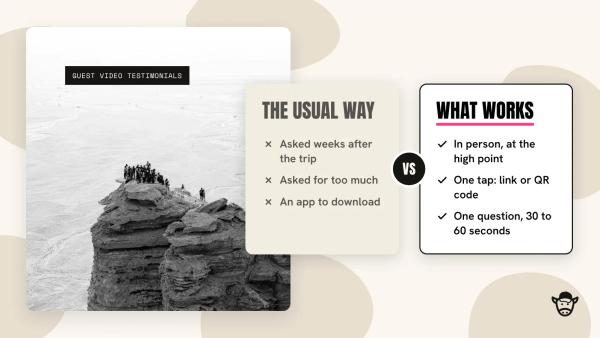

Most tour operators ask for reviews once, by email, a few days after the trip ends. By then the guest is back at work, the photos are on their phone and the feeling has faded. Review timing on a tour decides how many guests say yes and how specific their words are.
On a multi-day trip you have something a hotel or a day tour doesn't: several days with the same people, and a guide who knows when the group is happiest. This guide covers when to ask, how to ask, and when to follow up.
When is the best time to ask for a review on a multi-day trip?
Ask on the trip, just after a high point, while the group is still together. Then follow up once, a few days after they get home.
That's two asks, and they do different jobs.
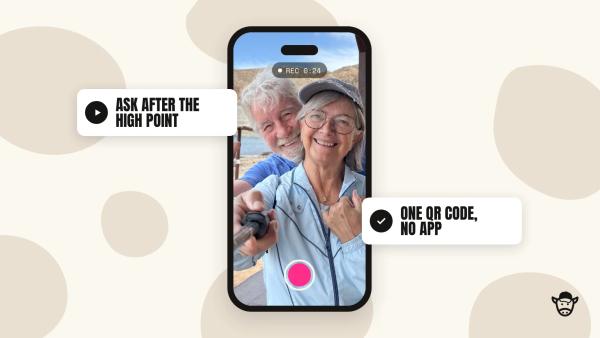
- The ask on the trip catches guests at their happiest. It's the best moment for a short video, recorded on their phone in 30 to 60 seconds.
- The follow-up after the trip catches guests who've had time to think. It's the best moment for a written review on Google or Tripadvisor.
Most operators only do the second one. Many send it the morning after the trip ends, which two studies suggest is often too soon.
Why does the high point matter so much?
Because people don't remember a trip as a long average of every hour. They remember the best moment and the end.
Psychologists Barbara Fredrickson and Daniel Kahneman showed this in 1993. When people rated an experience afterward, their ratings were well predicted by two moments: the most intense one (the peak) and the final one (the end). How long the experience lasted had little effect (Fredrickson and Kahneman, Journal of Personality and Social Psychology, 1993). This is often called the peak-end rule.
For a seven-day tour, that's useful. Your guests will judge the whole trip by its best day and its last day. So those are the moments to ask, and the moments to get right.
What are the best moments to ask on a multi-day tour?
Here's how the moments compare on a typical small-group tour of five to ten days.
- Day one. Good for: nothing yet. Watch out for: too early, guests haven't had the trip.
- Just after a highlight day in the second half. Good for: video reviews. Watch out for: keep it short, people are tired and happy.
- The farewell dinner. Good for: video reviews and group clips. Watch out for: don't ask after the second bottle of wine.
- The final transfer or airport drop. Good for: a reminder of the link. Watch out for: it's rushed, guests are thinking about flights.
- A few days after getting home. Good for: written reviews. Watch out for: too late for video, and too soon is a problem too.
The highlight is different on every trip. It might be the morning the group reaches the summit, the cooking class in a family kitchen or the day the whales show up. Your guide knows. Ask them to pick the moment, not the itinerary.
Just after a highlight day
This is the strongest moment for video. The group has just done the thing they booked for, and they want to talk about it. Ask that evening, or right after, while they're still buzzing.
Keep it to one question about what just happened. "What did you think of today's hike?" gets a better answer than "How's the trip going?"
The farewell dinner
The end of the trip is the other moment people remember. A farewell dinner or final night is a natural time to ask, and guests who didn't record earlier often will now, because the group is doing it together.
Have the guide put the QR code on the table or say a few words before dessert. Don't make it a speech.
After the trip
This is when written reviews come in. Guests are home, they've looked through their photos and they can write about the whole trip.
But don't send it the next morning. Researchers ran a field experiment on South Korea's largest online travel marketplace, sending review reminders the next day, after five days, after nine days and after 13 days. Asking as soon as possible wasn't the best strategy. Reminders caused problems when they arrived before people would usually write a review. Later reminders produced more specific reviews (Jung, Ryu, Han and Cho, Journal of Marketing, via the American Marketing Association, 2023).
A larger study of 22.3 million review requests points the same way. Response rates fell as the gap between purchase and request grew. But sellers of experiences and other high-involvement purchases should generally wait longer before asking (Poniatowski, Seutter, Ryu and Kundisch, Paderborn University, 2024). The same study found two daily peaks in responses, around noon and in the early evening.
A multi-day tour is about as high-involvement as travel gets. Give guests a few days to land, then ask once.
How should you ask, so guests actually do it?
The moment matters, but so does the ask. A few things make the difference.
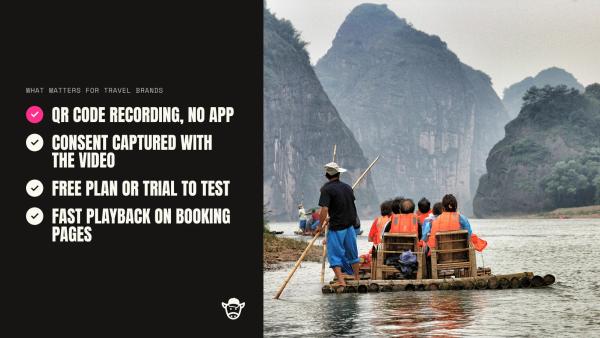
- Make it one tap. One link or one QR code that opens a recorder in the phone's browser. No app to download, no account.
- Have the guide ask in person. A request from someone the group has spent a week with lands very differently from an automated email.
- Ask one specific question. Name the day, the place or the activity. Specific questions get specific answers.
- Keep it short. 30 to 60 seconds of video, or a few lines of text. Say so up front.
- Get consent in your own words. Before any video goes on your site, the guest should agree to how you'll use it. This isn't legal advice, so check the rules where you operate. Our guide to GDPR and video embeds covers the hosting side.
Why don't more guests record? We'd say it's because they're not sure what to say. Give them a clear question to answer that you know they will be excited to share, then it becomes easier.
Why do recent reviews from every departure matter?
Because people booking a trip look for recent proof, and one great review from two years ago doesn't answer the question "is this trip still good?"
Tripadvisor and Ipsos MORI surveyed more than 23,000 Tripadvisor users. 78% said they focus on the most recent reviews, and 52% would never book a hotel with no reviews (Tripadvisor, 2019). The same survey found the top reason people write reviews is to share a good experience with other travelers, at 87%.
Guests want to share. Arival's research on US experience travelers found more than half wrote an online review of a tour they'd taken (Arival, 2024). Your job is to make it easy and to ask at the right moment, on every departure.
What is the peak-end rule?
The finding that people judge an experience mostly by its most intense moment and its final moment, rather than by an average of every moment. Duration has little effect.
Key concepts
- Peak-end rule
- People judge an experience mostly by its most intense moment and its final moment.
- Review timing
- When you ask a guest for a review, measured from the moment of the experience.
- Review reminder
- A follow-up message asking a guest who hasn't reviewed yet to leave one.
- Recording prompt
- A short, specific question shown while the guest records, such as "What did you think of today's hike?"
- Consent on file
- The guest's written agreement to how you'll use their video, stored with the clip.
SuperMoo insights
- Across SuperMoo customers, the share of guests who record a video after getting the link varies greatly, from 1.5% to 11%. When they record depends on the type of business, but asking just after a peak of the experience usually works.
- We have no specific numbers to share, but anecdotally we know just after a peak experience of a tour is the best time to ask, while travelers are buoyant and want to share their experience.
What have we learned from SuperMoo customers?
The share of guests who record a video after getting the link varies greatly, from 1.5% to 11%. Even at the top of that range, most guests don't record, so ask every group.
When guests record depends on the type of business.
We have no specific numbers to share, but anecdotally we know just after a peak experience of a tour is the best time to ask, while travelers are buoyant and want to share their experience.
What mistakes should you avoid?
- Asking on day one. Guests haven't had the trip yet.
- Asking only by email after the trip. You miss the moment when guests are happiest and most likely to record.
- Sending the follow-up the next morning. Give people a few days to get home.
- Sending reminder after reminder. One follow-up is enough.
- Asking a generic question. "How was it?" gets "Great, thanks." Ask about a specific day.
- Scripting guests. Prompts help. Scripts make everyone sound like an ad.
- Offering a reward for a positive review. Ask for honest feedback and never make a reward depend on what guests say.
- Hiding the results. Put the best videos on the trip page they're about, next to the price and the button. Our guide on how to embed customer testimonial videos on your website covers placement.
How does this fit into getting more bookings?
Reviews only help if people see them where they decide. A guest video from last month's departure, on that trip's page, answers questions a description can't: who goes on this trip, and did they have a good time?
Our travel conversion playbook shows where reviews sit in the path from first visit to booking. For the full list of tactics, see how to get more tour bookings, ranked by effort and impact.
Key numbers
- Peak and end: people's ratings of an experience are well predicted by its most intense moment and its final moment, while duration has little effect. Source: Fredrickson and Kahneman, Journal of Personality and Social Psychology, 1993.
- Next day, 5, 9 and 13 days: the reminder timings tested on South Korea's largest online travel marketplace, where asking as soon as possible was not the best strategy. Source: Jung, Ryu, Han and Cho, Journal of Marketing, 2023.
- 22.3 million: review requests studied, with response rates falling as the gap between purchase and request grew. Source: Poniatowski, Seutter, Ryu and Kundisch, Paderborn University, 2024.
- 78%: Tripadvisor users who focus on the most recent reviews. Source: Tripadvisor and Ipsos MORI, 2019.
- 87%: Tripadvisor users whose top reason for writing a review is to share a good experience. Source: Tripadvisor and Ipsos MORI, 2019.
- More than half: US experience travelers who wrote an online review of a tour. Source: Arival, The 2024 U.S. Experiences Traveler, 2024.
- 1.5% to 11%: the share of guests who record a video after getting the link, across SuperMoo customers. Source: SuperMoo customers, 2026.
Where to start
Pick your next departure. Ask the guide to choose the highlight day and the farewell moment, print one QR code and write one specific question for each. Then set your written review request to go out a few days after guests get home.
Start a 7-day free trial and set it up for your next departure. See how it works for travel brands or how SuperMoo collects guest videos.
That's SuperMoo.
Sources
- Fredrickson and Kahneman: Duration Neglect in Retrospective Evaluations of Affective Episodes (1993)
- American Marketing Association: Asking for Customer Reviews at the Right Time: Sooner Is Not Always Better (2023)
- Poniatowski, Seutter, Ryu and Kundisch: When to Ask for a Review (Paderborn University, 2024)
- Tripadvisor: Online Reviews Remain a Trusted Source of Information When Booking Trips (2019)
- Arival: Google Surges Past Tripadvisor as Travelers' Top Spot for Posting Reviews (2024)