
Video testimonials are short clips of real guests talking about their trip, recorded on their own phone and shown on your website. For travel brands they do one job better than anything else you can publish. They let a stranger see someone like them having a good time with you, right when they're deciding whether to book.
This guide is the hub for everything we've written on the topic. It covers what to ask, when to ask, how to get consent, where to put the videos and how to keep them from slowing your site down.
What is a video testimonial in travel?
A video testimonial is a guest, in their own words, saying what the trip was like. It isn't an ad and it isn't a polished brand film. It's usually 30 to 60 seconds, filmed on a phone, often outdoors, sometimes a little shaky.
That's the point. People booking a tour, a hotel stay or a boat trip are buying something they can't try first. Written reviews help, but a face and a voice answer questions text can't: Who goes on this trip? Were they actually having fun? Would I fit in?
The best ones come from guests at the end of a tour, at hotel check-out or back on the dock after a boat trip. Group trip leaders are worth asking too. A teacher or a club organizer speaks for a whole group.
Why do video testimonials work for travel brands?
Because travel is a high-trust, high-price purchase, and people lean on other travelers before they spend.
Personal recommendations still carry weight. In ABTA's Holiday Habits 2025-26 survey of 2,001 UK adults, recommendations from friends and family were the second most common way to choose where to go, at 41%. Only internet searches ranked higher, at 48% (ABTA, 2025). A guest video is the closest thing to that recommendation you can put on your own site.
Good reviews also let you charge more. Cornell's Center for Hospitality Research found a hotel whose review score rose 1 point out of 5 could charge 11.2% more and keep the same occupancy (Cornell, 2012).
People also look for fresh proof. In BrightLocal's 2026 survey of 1,002 US consumers, 97% use reviews to guide their purchase decisions. And 74% only care about reviews written in the last three months (BrightLocal, 2026). A steady trickle of new guest videos does more than one big shoot every few years.
And travelers want video. In Expedia Group's 2025 survey of 7,000 travelers in seven markets, 71% said video had influenced their travel decisions, against 24% for static images (Expedia Group, 2025).
The catch: most of your best reviews live on Google, Tripadvisor and booking sites, where they sit next to your competitors. Video testimonials on your own pages keep that proof where you take the booking. Our travel conversion playbook covers the rest of that journey.
How do travel brands collect video testimonials?
There are three ways, and most brands end up with the third.
- Hire a film crew. Beautiful results, but expensive, slow and hard to repeat. You get a few guests on one day, not a steady stream.
- Ask guests to send you a clip. Free, but the files arrive by WhatsApp, email and shared drives, in every format, with no consent on record.
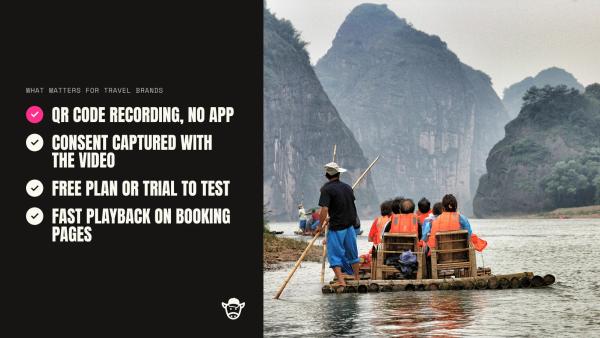
- Use a collection tool. You send one link or show a QR code, the guest records in their phone's browser, and the video lands in one place with consent attached. That's what SuperMoo does.
Whichever route you choose, the steps are the same.
Step 1: Pick the moment
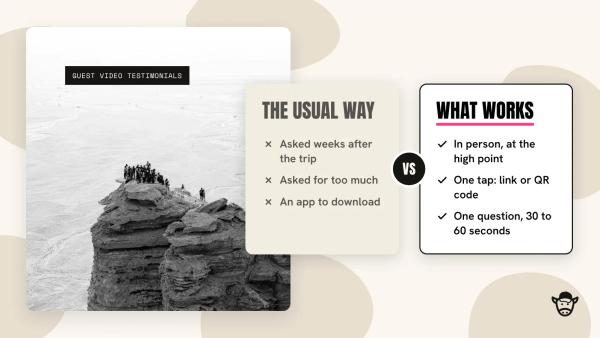
Ask just after the high point, not a week later by email. For a day tour that's the last stop. For a hotel it's check-out or breakfast on the final morning. For a multi-day trip it's the farewell dinner or the bus back to the airport. The further you get from the moment, the fewer people say yes.
Step 2: Make it one tap
Every extra step loses people. One link or one QR code, no app to download, no account to create. Put the QR code where guests already wait: the reception desk, the boat's exit ramp, the back of the menu, the guide's lanyard.
Step 3: Ask one or two specific questions
A blank camera makes people freeze, so show a question on screen while they record. Make it about something specific in the trip, and pick one or two for each recording:
- What did you think of [the sunset sail]?
- What was the best thing about [your stay]?
- Who would you tell to book [this tour], and why?
Keep it to 30 to 60 seconds. Short clips get finished, and they get watched.
Step 4: Get consent in your own words
Before anything goes live, the guest should agree to how you'll use the video, in plain words you've written. Keep that consent on file with the clip. Our guide to GDPR and video embeds covers the hosting side.
Step 5: Approve and pick the best
Not every clip needs to go live. Watch them, keep the ones that are clear and specific, and trim the first and last few seconds if there's fumbling with the phone.
Step 6: Put them where people decide
A testimonial video on a page nobody visits does nothing. Put them on the pages where people make up their minds: trip pages, room pages, the booking page. More on that below.
When should you ask guests for a video testimonial?
The right moment depends on what you sell. Just after a peak of the experience usually works.
- Day tours and activities: Last stop, while the group is still together
- Hotels and resorts: Check-out, or breakfast on the final morning
- Boats and charters: Back on the dock, before people scatter
- Multi-day and group tours: Farewell dinner or the final transfer
- School and group trips: The trip leader, the week after you get home
For group trips the leader's voice carries extra weight. A teacher or club organizer speaks for everyone on the trip, and the people booking the next one are often in the same role. We cover this audience in how schools collect parent and student video testimonials.
What questions should you ask in a video testimonial?
Good prompts ask for a story. "Was it good?" gets a yes. "What was the best moment?" gets a story.
We've found the most natural, usable answers come from questions about a specific part of the experience and what the guest thought of it. A few that work across travel:
- What did you think of [the cooking class, the guide's stories, the view from your room]?
- What was the moment you'll remember?
- What were you worried about before you booked, and how did it turn out?
- Who was your guide or host, and what did they do?
- Who would you tell to book this?
- What would you say to someone on the fence?
Pick one or two for each recording. The fewer questions you ask, the more usable the answer tends to be.
What is a video testimonial?
A short video of a real customer describing their experience in their own words, usually 30 to 60 seconds and recorded on their own phone, published with their consent on the business's website and channels.
Key concepts
- Video testimonial
- A short clip of a real customer describing their experience in their own words, published with their consent.
- Collection link
- One link or QR code that opens a recorder in the guest's phone browser, with no app to install.
- Recording prompt
- A short question shown while the guest records, such as "What did you think of the sunset sail?", that guides them without scripting them.
- Consent on file
- The guest's written agreement to how you'll use their video, stored with the clip.
- Play rate
- The share of page visitors who press play on a video, a first sign of whether it's placed well.
SuperMoo insights
- Across SuperMoo customers, the share of guests who record a video after getting the link varies greatly, from 1.5% to 11%. When they record depends on the type of business, a hotel or a visitor attraction for example, but asking just after a peak of the experience usually works.
- The questions that get the most natural, usable videos ask something specific about the experience and what the guest thinks of it, rather than a generic question.
Where should travel brands use video testimonials?
Start with the pages closest to the booking, then work outward.
- Trip and room pages. Put one or two videos near the price and the booking button. This is where doubts peak.
- Your homepage. One strong clip that sums up the feeling of a trip with you.
- Booking and inquiry pages. A short clip next to the form can settle last-minute nerves.
- Your Google Business Profile and social channels. Repurpose the same clips, with the guest's consent.
- Emails to people who inquired but haven't booked. A guest video is a gentler follow-up than another discount.
Match the video to the page. A family on a beach tour belongs on the family beach tour page, not on the adults-only cruise.
Our guide on how to embed customer testimonial videos on your website walks through placement and embed options.
How do you keep video testimonials from slowing your site?
This is where many travel sites go wrong. A standard YouTube embed loads a lot of code before anyone presses play, and it can show other people's videos when yours ends, including your competitors'.
Slow trip pages cost bookings, especially on mobile, where most travel browsing starts. Use a lightweight player that only loads the video when someone clicks, shows your branding and has no ads. SuperMoo's player loads in 0.18 seconds with zero ads, but whatever you use, test the page before and after.
We go deeper in how your video player is slowing your PageSpeed score.
What mistakes should travel brands avoid with video testimonials?
- Don't script guests. Prompts help. Scripts make everyone sound like an ad, and viewers can tell.
- Don't ask generic questions. Ask about a specific part of the experience and what the guest thought of it.
- Don't ask only once. One shoot gives you a handful of videos that age fast. Ask every group, every week.
- Don't hide them on a testimonials page. Few people visit it. Put the videos on the pages where people book.
- Don't skip consent. Get it in writing, in your words, before anything goes live.
- Don't edit out the personality. A laugh, a wave or a slightly windy clip is more convincing than a perfect one.
- Don't invent or polish quotes. Only publish what guests actually said, in the words they used.
How do you know if video testimonials are working?
Measure the pages you put them on, before and after. If you sell through a form, track the inquiry rate. If you take bookings online, track the booking rate. Add the play rate to see whether people watch at all.
Compare the same season, split by device, and give it a few weeks. Our travel website conversion rate benchmarks explain how to measure each one.
What have we learned from SuperMoo customers?
Recording rates vary a lot. Across SuperMoo customers, the share of guests who record a video after getting the link runs from 1.5% to 11%. Even at the top of that range, nearly nine in ten guests don't record, so ask every guest.
When guests record depends on the type of business: a hotel works differently from a visitor attraction. Asking just after a peak of the experience usually works.
The questions matter too. The ones that get the most natural, usable videos ask something specific about the experience and what the guest thinks of it, rather than a generic question.
Key numbers
- 41%: UK adults who choose where to travel from recommendations by friends and family, second only to internet searches (48%). Source: ABTA Holiday Habits 2025-26.
- 11.2%: how much more a hotel could charge, at the same occupancy, after its review score rose 1 point out of 5. Source: Cornell Center for Hospitality Research, 2012.
- 71%: travelers who say video influenced their travel decisions, against 24% for static images. Source: Expedia Group, 2025.
- 97%: consumers who use reviews to guide their purchase decisions. Source: BrightLocal Local Consumer Review Survey, 2026.
- 74%: consumers who only care about reviews written in the last three months. Source: BrightLocal Local Consumer Review Survey, 2026.
- 57%: video marketers who have made video testimonials. Source: Wyzowl Video Marketing Statistics, 2026.
Where to start
Pick one trip or one room type. Choose the moment, print one QR code, write one or two specific questions and ask every guest for two weeks. Put the best two videos on that page and watch the inquiry or booking rate.
To do all of that with SuperMoo, start a 7-day free trial. See how it works for travel brands.
That's SuperMoo.
Sources
- ABTA: Holiday Habits 2025-26, where people get holiday inspiration (2025)
- Cornell Center for Hospitality Research: The Impact of Social Media on Lodging Performance (2012)
- Expedia Group: Study reveals new insights in travel content amid AI boom (2025)
- BrightLocal: Local Consumer Review Survey 2026
- Wyzowl: Video Marketing Statistics 2026